The Mantle of Command by Nigel Hamilton
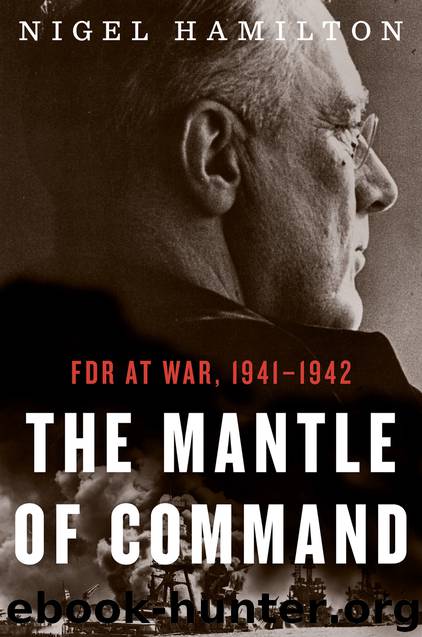
Author:Nigel Hamilton
Language: eng
Format: epub
Publisher: Houghton Mifflin Harcourt
Poor Harry Hopkins, having handed over the rest of the President’s cable, now witnessed Churchill’s meltdown.
Hopkins, sickly but willing to do anything for his revered president, had traveled to London with General Marshall to ensure that U.S. planning to aid the Russians was not stymied by British bureaucracy and timidity. The spat over India, however, now banished European war plans to a back seat—Hopkins later telling Robert Sherwood that no “suggestions from the President to the Prime Minister in the entire war were so wrathfully received as those relating to solution of the Indian problem.”37 To the secretary of war, Colonel Stimson, Hopkins even confided, on his return to Washington, “how a string of cuss words lasted for two hours in the middle of the night” in London38—with Churchill adamant he would rather resign than permit an American president to dictate British imperial conduct. It was no idle threat.
The fact was, Churchill seemed exhausted, as all around him had noticed. He was drinking more, sleeping less, and busying himself in the minutiae of military operations across the world that he seemed unable or unwilling to delegate. The Australian prime minister had made it clear he had lost confidence in Churchill’s leadership, and the Pacific War Council in London was entering its “death throes”—soon to be entirely replaced by the Pacific War Council in Washington. Japanese naval forces were roaming at will like sea monsters off the coast of India—and British forces were in helter-skelter retreat in northern Burma, abandoning their Indian units to be killed or captured. General Rommel was once again forcing British Empire troops to retreat in Libya.
However, as one of Churchill’s own “closest and most affectionate associates” later confided to Hopkins’s biographer, “the President might have known that India was one subject on which Winston would never move a yard.”39 Certainly Indian self-government, as Robert Sherwood recalled Hopkins telling him, was “one subject on which the normal, broad-minded, good-humored, give-and-take attitude which prevailed between the two statesmen was stopped cold”—indeed Churchill, rounding on the hapless Hopkins, told him he “would see the Empire in ruins and himself buried under them before he would concede the right of any American, however great and illustrious a friend, to make any suggestion as to what he should do about India.”40 Calling in his stenographer, the Prime Minister was determined to put his feelings in writing. To the President he therefore dictated a nasty rebuke.
“A Nationalist Government such as you indicate would almost certainly demand,” he deceitfully claimed, “first, the recall of all Indian troops from the Middle East, and secondly, they might in my opinion make an armistice with Japan on the basis of free transit through India to Karachi of Japanese forces and supplies.”41
For Churchill to send such unqualified “opinions” was sailing close to dishonesty. Both claims were specious, as Churchill and the viceroy (with whom Churchill was in secret correspondence, bypassing Sir Stafford Cripps) well knew—contradicting the assurances Nehru had given Cripps and the President’s “Special Emissary,” Colonel Johnson.
Download
This site does not store any files on its server. We only index and link to content provided by other sites. Please contact the content providers to delete copyright contents if any and email us, we'll remove relevant links or contents immediately.
| Africa | Americas |
| Arctic & Antarctica | Asia |
| Australia & Oceania | Europe |
| Middle East | Russia |
| United States | World |
| Ancient Civilizations | Military |
| Historical Study & Educational Resources |
The Radium Girls by Kate Moore(12093)
100 Deadly Skills by Clint Emerson(4972)
Rise and Kill First by Ronen Bergman(4838)
The Templars by Dan Jones(4736)
The Doomsday Machine by Daniel Ellsberg(4550)
The Rape of Nanking by Iris Chang(4256)
Killing England by Bill O'Reilly(4042)
Stalin by Stephen Kotkin(4006)
Hitler in Los Angeles by Steven J. Ross(3981)
12 Strong by Doug Stanton(3578)
Hitler's Monsters by Eric Kurlander(3385)
The Code Book by Simon Singh(3251)
Blood and Sand by Alex Von Tunzelmann(3240)
Darkest Hour by Anthony McCarten(3161)
The Art of War Visualized by Jessica Hagy(3043)
Hitler's Flying Saucers: A Guide to German Flying Discs of the Second World War by Stevens Henry(2777)
Babylon's Ark by Lawrence Anthony(2718)
Tobruk by Peter Fitzsimons(2559)
The Second World Wars by Victor Davis Hanson(2554)
